I recently attended the APS March Meeting where I attended the Physics Of Cancer Tutorial and spoke in 1 of the 3 "Physics of Cancer" scientific sessions. I knew that there wasn't much "medical physics" in APS, so I was interested in seeing what research on cancer there was.
I think I finally understand the difference between biophysics and medical physics. Many of the talks in the Physics of Cancer session focused on physical properties of cancer cells. What are their elastic properties? Do metastatic cells show different physical properties (size, squishyness) from non-metastatic cancer cells? How much force can cancer cells exert on eachother? One of the talks argued that metastatic vs non-metastatic cancer cells do have different physical properties even if there aren't clear genetic differences.
Friday, March 9, 2012


Friday, February 10, 2012
Dear Senator Boxer
Dear Senator Boxer,
I'm a physics PhD student at Stanford University. I do cancer research and my career goals are to stay in academia and continue doing research into how cancer can be better imaged and treated. I will be graduating in about a year and will soon be looking for post-doctoral research positions.
It is highly likely that my next job will be at a university or hospital. I'd like to find research that will benefit from my skill-set and has the potential to help many cancer patients. But what if that group is at a Catholic Hospital or University? As a student, I have never had to worry about whether my health insurance (provided through the university) covered what I needed. Now my future career plans may be limited or changed based on provided health care.
I have an IUD, which means that I will need to get it replaced or removed in a few years. If I had to pay out of pocket, that could easily be $1000. Without the new health care rules that would ensure my employer would cover contraception, how could I know this would be covered? When looking at a position, will I need to call HR and find out whether the health care plan covers contraception? Who can provide assurance that the plans would not change? There are many leading research universities and hospitals with a religious affiliation, so this is a real concern for me. It isn't one that the men in my lab worry about.
Thank you for supporting contraception access. I find the conversation right now horrifying - a bunch of men thinks it limits their religious freedom if I have access to contraception. I wish I could tell them about my latest cancer treatment research and explain to them that it wouldn't be happening if I had children to take care of at home. I am able to make contributions to science - perhaps that they will benefit from - because I have control over my body and whether I have children.
Thank you for being an elected politician I can count on.
-Nicole Ackerman
I'm a physics PhD student at Stanford University. I do cancer research and my career goals are to stay in academia and continue doing research into how cancer can be better imaged and treated. I will be graduating in about a year and will soon be looking for post-doctoral research positions.
It is highly likely that my next job will be at a university or hospital. I'd like to find research that will benefit from my skill-set and has the potential to help many cancer patients. But what if that group is at a Catholic Hospital or University? As a student, I have never had to worry about whether my health insurance (provided through the university) covered what I needed. Now my future career plans may be limited or changed based on provided health care.
I have an IUD, which means that I will need to get it replaced or removed in a few years. If I had to pay out of pocket, that could easily be $1000. Without the new health care rules that would ensure my employer would cover contraception, how could I know this would be covered? When looking at a position, will I need to call HR and find out whether the health care plan covers contraception? Who can provide assurance that the plans would not change? There are many leading research universities and hospitals with a religious affiliation, so this is a real concern for me. It isn't one that the men in my lab worry about.
Thank you for supporting contraception access. I find the conversation right now horrifying - a bunch of men thinks it limits their religious freedom if I have access to contraception. I wish I could tell them about my latest cancer treatment research and explain to them that it wouldn't be happening if I had children to take care of at home. I am able to make contributions to science - perhaps that they will benefit from - because I have control over my body and whether I have children.
Thank you for being an elected politician I can count on.
-Nicole Ackerman
Thursday, February 9, 2012
Faculty Benefits
As part of my fellowship, I am visiting a few local campuses this quarter. So far I have visited Santa Clara University and Foothill College. The goal of these visits is to understand different types of institutions, specifically how it differs to be faculty at different types of institutions. I am greatly enjoying these visits and am seeing that there is a lot to be excited about at all institutions.
There are some big questions we are getting answered at every visit: How is hiring done? What is the tenure process? Sometimes the discussion turns to the mundane topics of employment - wages and benefits. I don't feel particularly concerned about these topics. If I was working as a part time faculty (adjunct) I would have issues of low pay and no benefits. But as long as I am full-time (tenure track), I should be able to live, right? As I recently learned, community college faculty are fairly well paid. What would I possibly need to worry about?
There are some big questions we are getting answered at every visit: How is hiring done? What is the tenure process? Sometimes the discussion turns to the mundane topics of employment - wages and benefits. I don't feel particularly concerned about these topics. If I was working as a part time faculty (adjunct) I would have issues of low pay and no benefits. But as long as I am full-time (tenure track), I should be able to live, right? As I recently learned, community college faculty are fairly well paid. What would I possibly need to worry about?
Tuesday, January 10, 2012
Gender+Science in toys: yay Lego!
I loved Legos when I was young. I'm a little critical of the fact that now everything is very expensive kits that seem more like model building (without the painting and gluing) than they are creative construction. I don't think they are all bad - I had some sort of undersea explorer kit that I build once and then combined with all of my other blocks.
Of course, there are Legos for girls. This is problematic when it send the message that girls can only play with things that are pink and cute (though many plain kits are labeled "for girls"). However, for families that are already in that mentality, it at least provides a more creative play opportunity than most of the "girl toys" out there.
So mega-points for Lego for introducing Olivia's Invention Workshop. It is an affordable accessory that is marketed towards girls with a focus on science/engineering. Microscope! Tools! Table vice! Maybe the kids playing with this will decide the next robot Olivia makes will be a giant Gundam. I would approve!
Of course, there are Legos for girls. This is problematic when it send the message that girls can only play with things that are pink and cute (though many plain kits are labeled "for girls"). However, for families that are already in that mentality, it at least provides a more creative play opportunity than most of the "girl toys" out there.
So mega-points for Lego for introducing Olivia's Invention Workshop. It is an affordable accessory that is marketed towards girls with a focus on science/engineering. Microscope! Tools! Table vice! Maybe the kids playing with this will decide the next robot Olivia makes will be a giant Gundam. I would approve!
Tuesday, December 13, 2011
Standard Model Higgs?
There was a big exciting seminar at CERN today regarding new Higgs search results. The short summary is that there is 2 - 3 sigma (not good enough to say for sure) evidence for a Standard Model Higgs particle around 125 GeV in a few channels. Awesome scientific summaries can be found here and here.
My first thought: how close was Fermilab? (Second thought: which people think they are getting the Nobel Prize for this). Remember that the Tevatron was also built to find the Higgs. Everyone on it tried really hard, but didn't end up doing it. I did some searching for Tevatron Higgs results (especially looking in the channels where the LHC experiments are seeing signals) and the picture is somewhat painful. The Tevatron had hints in the right region for the two photon channel.

The image above shows the level of exclusion for the different Higgs masses from the Tevatron. The lower the thick black line goes, the more sure the Tevatron people are that the Higgs isn't there. The dotted black line represents how good they thought they could do. It is interesting to not the 125 GeV region. First, it is one of the "highest" points on the plot, meaning that they had the least ability to say "there isn't a Higgs there". Second, it is about 2 sigma up from what they expected to see.
If further LHC data shows that the Higgs is at about 125 GeV, this means that the Tevatron had come very close to seeing it. Perhaps with a little more time they would have gotten it. On the other hand, there could be tricky backgrounds in that area that affected both experiments.
My first thought: how close was Fermilab? (Second thought: which people think they are getting the Nobel Prize for this). Remember that the Tevatron was also built to find the Higgs. Everyone on it tried really hard, but didn't end up doing it. I did some searching for Tevatron Higgs results (especially looking in the channels where the LHC experiments are seeing signals) and the picture is somewhat painful. The Tevatron had hints in the right region for the two photon channel.
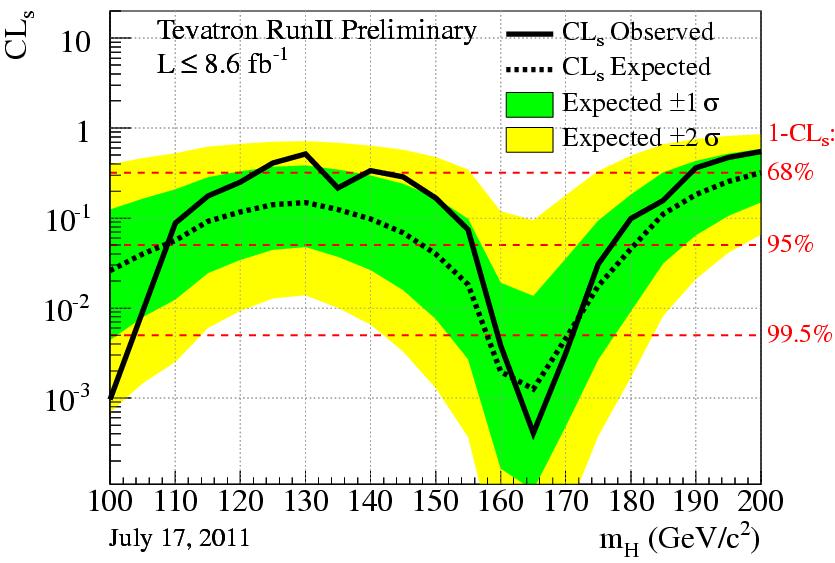
The image above shows the level of exclusion for the different Higgs masses from the Tevatron. The lower the thick black line goes, the more sure the Tevatron people are that the Higgs isn't there. The dotted black line represents how good they thought they could do. It is interesting to not the 125 GeV region. First, it is one of the "highest" points on the plot, meaning that they had the least ability to say "there isn't a Higgs there". Second, it is about 2 sigma up from what they expected to see.
If further LHC data shows that the Higgs is at about 125 GeV, this means that the Tevatron had come very close to seeing it. Perhaps with a little more time they would have gotten it. On the other hand, there could be tricky backgrounds in that area that affected both experiments.
Thursday, December 8, 2011
Accepted!
After consulting a proof-reader, cursing the existence of referee 3, and finding one last mistake: my Cerenkov paper has been accepted to Physics in Medicine and Biology! I thought I would feel... different, somehow. But no. My to-do list isn't any shorter and I still don't have a PhD. What was the point of all of that work then?
Friday, December 2, 2011
Gendered Science Kits
Remember the good ol' days of chemistry kits filled with things that could potentially be dangerous in any way whatsoever? I barely do. The only one I ever had like that was 2nd hand - probably originally from the 80s.
From my own experience trying to buy "educational" toys I have found that anything that isn't a videogame is considered educational. Toy trains and trucks? Professional Development. Nerf gun? Hand-eye coordination. Stuffed animals? Biology! I don't buy it.
Sadly, "science kits" have gone a bit downhill as well. I don't think there is anything fundamentally wrong with a slime kit or crystal growth kit, but there is too much "value added" plastic crap in these kits as an attempt to justify the high price tag. But it has gotten worse - these kits are becoming increasingly gendered.
Professor Janet D. Stemwedel at SciAm Blogs has an excellent series on this topic:
From my own experience trying to buy "educational" toys I have found that anything that isn't a videogame is considered educational. Toy trains and trucks? Professional Development. Nerf gun? Hand-eye coordination. Stuffed animals? Biology! I don't buy it.
Sadly, "science kits" have gone a bit downhill as well. I don't think there is anything fundamentally wrong with a slime kit or crystal growth kit, but there is too much "value added" plastic crap in these kits as an attempt to justify the high price tag. But it has gotten worse - these kits are becoming increasingly gendered.
Professor Janet D. Stemwedel at SciAm Blogs has an excellent series on this topic:
Subscribe to:
Posts (Atom)